

Corinth Canal
"Labour strategist warns against shift to remain after local elections."
There are two quite separate things to see around Corinth, one is Ancient Corinth and the other is the Corinth Canal. Unfortunately they are about 15km apart which it makes it impossible to camp in one place and walk to both of them (well for us anyway).
So we decided to camp at the much recommended, if slightly eccentric Camper-Stop Korinth (37.91178 22.87804). Ancient Corinth is about 400m uphill from the Camper-Stop as are a couple of small supermarkets and lots of restaurants.
At this point it may be useful to outline the different levels of "campsite" in Greece. There are "proper" campsites often with pools, shops and restaurants. These sites cater for motorhomes, caravans and tents. They tend to charge around €25.00 per night in low season 2019.
Then there are Camper-Stops, these are only for motorhomes (though a few caravans seem to be permitted) but certainly no tents. You are not permitted to get your table and chairs out, or to put up your awning. They may have electricity and water. They tend to charge around €13.00 per night.
Then there are public parking areas where motorhomes routinely park overnight. Often these (rather confusingly) have "No Camping" signs (often with a crossed out picture of a caravan and tent).
There are at least two good points about Camper-Stop Korinth, one is the local wine for sale at €3.00 per litre bottle (for white, red is considerably more expensive at €4.00). The other good point is that the 83 year old owner will run you down to the canal (for a small fee) in his new if slightly battered car.
A quick look at a map will show that near Corinth there is a narrow isthmus of land that separates the Gulf of Corinth from the Aegean Sea. The idea of cutting a canal thru this isthmus has been around since antiquity. The first person to actually attempt digging a canal was the emperor Nero (with the help of 6000 Jewish prisoners of war).
Rather surprisingly they actually they managed to dig about 10% of the canal's length before they abandoned the idea.
From 1830 onwards various attempts were made by French companies to complete the canal but all ended in bankruptcy. The canal was finally completed in July 1893 by a Greek company. Since then it has been a resounding failure. Because of the canal's narrowness and strong tides many ship owners refused to use it. It is far too narrow for modern freight ships and is now mainly a tourist attraction.
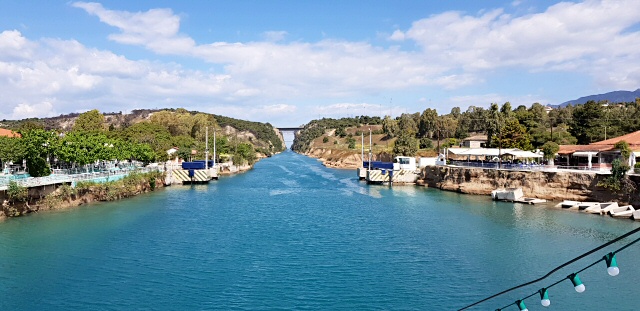
The canal is 6.4 km long and only 21.4 metres wide. It has no locks.
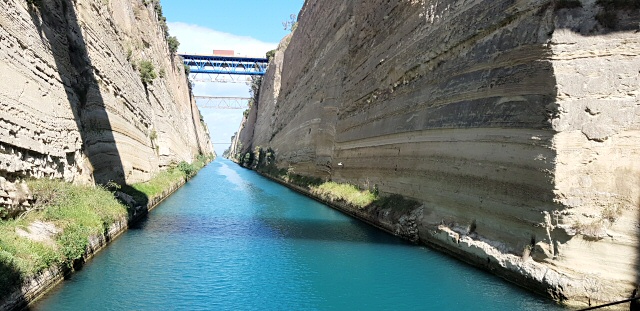
There are submersible bridges at each end of the canal that are lowered to allow ships to pass over them as well as high level road and train bridges in the middle.